
18 ways to design a better tourist experience for the Nürburgring
Idea’s from a designer who’s also crashed on the Nordschleife
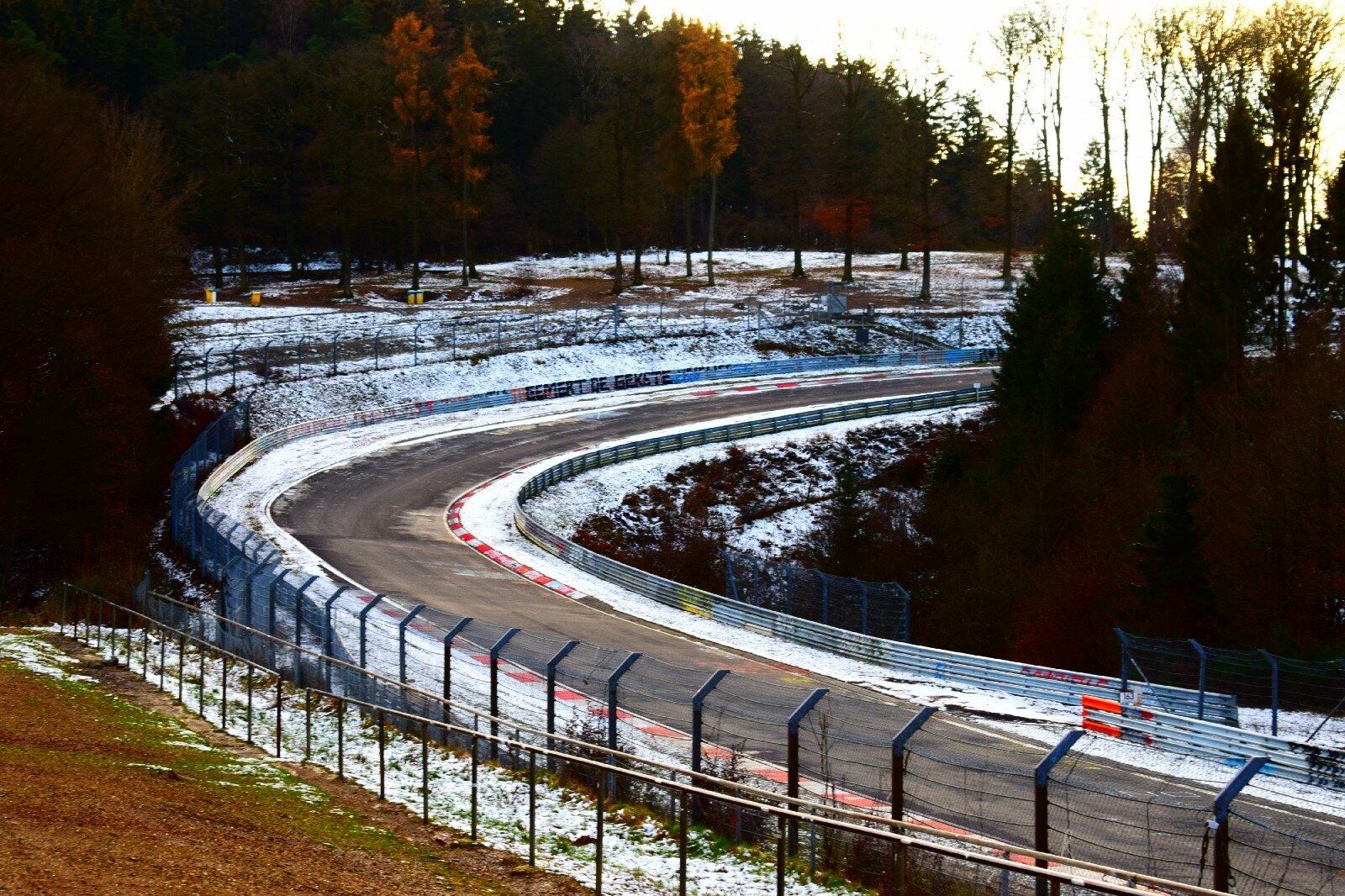
Nürburgring Brünnchen corner
(If you’re familiar with a tourist experience of the Nürburgring then you can just skip down to the list section of this article. For anyone else, I’d recommend reading the full account for context)
The Nürburgring — or the Green Hell — is the world’s most notorious race track. Its reputation brings drivers from across the world to complete a tourist lap.
If you’ve never been to the Nürburgring, let me explain what it’s like.
You arrive at the Nordschleife car park and it feels like Christmas day. Every kind of car imaginable is there. Supercars, hot hatches, Transit vans and an obligatory Volvo estate. There’s also a swarm of motorcycles; adventure bikes with middle-aged owners and sports bikes with riders in matching leathers.
To get onto the circuit you have to buy a plastic, credit card sized ticket that you use to prepay for laps. You can then get into your car and join the queue for the track entry barrier. Near the barrier there’s a sign telling you some rules:
A chart explaining the marshals’ flags
Instructions to stay to the right and let faster cars overtake
A reminder timing and filming your lap is forbidden
An emergency number for you to call if you crash
You reach the barrier, insert your ticket and wait for the lights to go green. Then you’re flooring it for the first time without worrying about consequences. It’s brilliant.
If you make it to the first corner without a faster car catching you, then well done, this next bit won’t be as scary. But if an M3 driven by an angry accountant is filling your mirrors, then things are a bit different. You’re unsure whether you’re allowed to take the racing line, or if you should pull as far to the right as possible.
The track is narrow, so the human calculator driving the M3 gets pissed off he can’t pass and flashes his lights. Finally, the track straightens and the M3 can overtake — followed by the other 4 cars you were holding up. You carry on at full speed until you hit a block of traffic. A middle-aged man in a sensible Skoda is ahead, driving a steady 60mph — we don’t want to have too much fun. Each time you think it’s safe to pull out, a faster car fills the space and you lose all momentum.
Finally, you spot a big enough gap in traffic and pass the fun blocking Skoda. You get enough clear track to take the racing line for the first time and exit the bend into a string of sport bikes.
Behind is a teenager in a Golf, without the self-preservation instincts your older brain has developed. He overtakes and inserts himself in the group of bikers who are furious they’re split up. You pray his erratic driving doesn’t result in a biker thrown over the barriers and into the forest.
You approach the most dangerous corner on the circuit. YouTubers who film accidents for a living are hoping you’ll make a mistake. You’re cautious enough to drive past unscathed, the teenager in the Golf isn’t.
He understeers as he overtakes a bike mid-corner, slams into the Armco and back onto the track. You swerve around the Golf, fighting your instinct to stop and help. If you do, you’re another object on the track to cause danger.
Adrenaline is pumping and sweat is flowing. Faster cars keep overtaking and slower cars keep blocking your progress. It’s liberating to drive this fast, but it’s not the racing experience you imagined. You enjoy some flow for a few turns, but then you see a man in orange waving a yellow flag. There’s an accident ahead. If it’s a bad accident, then a safety car will be on the track to slow everyone down. If someone has dropped oil or petrol on the track, then the yellow flag will last for the rest of your lap. A red flag will then shut the circuit until the surface is safe again.
So your experience ends with an anticlimax and white knuckles as you exit the track and return to the car park. The sensible decision is to drive onto the roads surrounding the track to cool your brakes. But many people will rejoin the queue for their next lap.
Video of Jaguar XJ6 on Nürburgring tourist lap. Filmed with permission. I didn’t crash on this visit.
What happened when I crashed
I made this mistake the second time I went to the ‘Ring. I was enjoying myself so much that I went back out for a third lap and suffered the consequences. As I applied the brakes into Pflanzgarten, nothing happened. The front left wheel hit the rumble strips and the I went into the Armco. I steered hard to the right and managed to find some grip so the rear of the car hit the barrier first. I was carrying enough speed to bounce off and onto the track facing the wrong way. The 911 behind me came so close that my passenger pulled off the entire interior door panel in terror.
My priority was to leave the middle of the track, then to face the right way. The MX5 was still running and the only visible damage was a broken light and bumper. Soil and grass spread across half of the track. It would have been great to know the emergency number you’re supposed to call after a crash. The rest of the lap was a conservative 50mph to the exit, at which point a marshal pulled me over.
The marshals didn’t speak great English, I didn’t speak much German. They escorted me into the back of a safety car and onto the track until we arrived where the crash happened. They pulled over on a narrow strip of grass and opened my door. Then they put a few cones around the debris and handed me a broom. I didn’t need to understand German to get the hint. As I swept up the soil, cars continued to pass at full speed.
After I cleaned my mess, the marshals took me back to their station; handing me a bill for the damage and their time. They informed me that I either pay or speak to the Polizei. I was aware of the consequences of crashing on the ‘Ring and bought insurance, but many people don’t. As I signed the forms and gave my credit card, they handed me some mint cake and a coffee. Then I was free to head back out on track again if I so wished.
The problems we need to solve
The ideas below are designed to address four key issues that I believe need solving to create a safer and more fulfilling tourist experience at the ‘Ring.
Number of vehicles on track
It can be so crowded on the narrow track of the the Nordschleife that despite the enormous length of the circuit, cars will bunch up into groups when they’re unable to overtake a slower vehicle. Having cars and bikes on the same track is something that I’ve never seen at another circuit because of the increased risk of collision and severe injury to motorcyclists.
Vehicle safety
There are no checks on vehicle safety. The track rules say that any vehicle should comply with German Road Traffic License Regulations but proof of this isn’t required before accessing the circuit.
Understanding of track safety
If you turn up at a track day in the UK, there’s usually a mandatory safety briefing explaining what the marshals’ flags mean, track rules and etiquette. You’re normally required to sign a form stating you understand these conditions and will comply with the rules.
Does his happen at the Nürburgring? Nope. For context, in 2016 there were 81 accidents involving tourists who were racing around the Nürburgring. Two people died, 18 were seriously injured and 43 suffered minor injuries.
Few consequences
“Honestly, the Nürburgring feels kind of like one of those tracks where literally anything goes. You can bring just about anything out there for a track day and mess around, spray paint the track if you think you can get away with it — you name it. Aside from outright reckless behaviour, it’s hard to imagine getting banned from the Nürburgring”
Elizabeth Blackstock for Jalopnik 2018
If you drive badly enough then you can get double flagged which means you need to exit the track. You might get a telling off or asked not to come back but I can find no evidence of this being enforced.
18 ways to design a better tourist experience for the Nürburgring:
Before arriving at the track
1. Mandatory Nürburgring account
A portal that enables visitors to register an account in order to collect driver details. At the bare minimum a name, address and email should be collected to monitor exactly who is in charge of a vehicle.
2. Proof of insurance
I’m talking specifically about track insurance. It covers the driver, the car and the circuit. From a psychological perspective, I believe mandatory insurance can help tourists realise that driving a race track is a serious undertaking with life and death consequences.
3. Proof of vehicle safety
Annual proof of vehicle road worthiness uploaded to driver account such as a UK MOT. At the very least this should mean tourist rides are in vehicles that have passed a minimum level of safety inspection.
4. Booked sessions
Grouping vehicles into session time slots enables further design improvements we’ll look at further down the list.
Before entering the track
5. Number stickers
A quick way for marshals and track control to identify cars on track. Would enable track officials to flag specific cars and identify problem drivers against their Nürburgring account.
6. Safety checklist
A basic checklist that the driver of each vehicle is responsible for. For example: fluid levels, tyre pressure, seatbelts etc.
7. Tyre and brakes safety inspection
Making sure tyres have adequate tread and brake pads aren’t worn down. Your tyres are the only thing between the road surface and your car, it’s impossible to overemphasise their importance.
8. Separate vehicles by performance
Within booked session times, group vehicles with similar performance together and stagger their release on to track. This should reduce the amount of vehicles being bunched together and allow each driver more opportunities for an enjoyable lap.
9. Mandatory safety briefing
This could be as simple as a training video where after watching, drivers then sign to acknowledge they understand the rules. It reinforces safety and provides accountability.
10. Helmets
Make wearing a helmet mandatory for car drivers and have a helmet hire facility onsite.
11. Towing eye
It’s standard practice at most track days to have your towing eye fitted before being allowed on the circuit.
On the track
12. Guided safety car laps
The Nordschleife is 12.9 miles long with about 100 turns. No one can learn the layout without many repetitions. Setting people lose without any guidance, tips or support focused on staying safe seems like an incredible dereliction of duty. Providing a guidance could take a few formats. Vehicles booked into sessions could follow a safety car for a lap. Audio guidance could follow a cars progress along the circuit via GPS.
13. Digital flags and more cameras
Finding enough volunteers to marshal tourist laps along a 12.9 mile circuit is difficult. The result is that marshal’s are few and far between. To fill the gaps, digital flags supported by cameras on the track and marshal feedback could highlight specific drivers whose behaviour needs modifying.
14. More track exits
Getting dangerous drivers off the track as quickly as possible should be a priority. We could empower marshals to remove bad drivers by having more frequent exits off the track. This also means the majority of good drivers can enjoy their laps safely.
15. Overtaking zones
There are already areas of the track where you’re forbidden to overtake, and it’s also illegal to overtake on the right of a vehicle. It seems to me that positive reinforcement through having specific overtaking zones can add some excitement to the experience in a safe way.
After the track
16. Mandatory cool down
After two laps, enforce a cool off period before being allowed back on track to give brakes and fluid levels a chance to cool down.
17. Rewards for good driving
The latest Gran Turismo game has a driver rating for each player online that then groups similar drivers together in lobbies. Breaking the rules and poor etiquette will see your driver rating plummet and you’ll end up playing with idiots who want to bump you off the track.
If you’re a safe driver, your experience at the ‘Ring shouldn’t be ruined by idiots. Knowing you’re on track with other conscientious drivers is a reward in itself, but it could also provide further benefits such as a reduced fee at the Nürburgring museum or a discount on helmet hire.
18. Gamified punishment
Ban people who are dangerous. A tourist lap shouldn’t be as dangerous as it is today. Most of that danger is behavioural, with the consequences emphasised by structural problems. Let’s assume that people who drive like arseholes are ignorant rather than terrible people. They may have spent a lot of money for a lap at the ‘Ring and despite being asked to exit the track early, want to atone. Asking these drivers to complete mandatory training exercises and assessments digitally could help incentivise reform, allowing another opportunity to drive the Nordschleife.
Summary
Driving the Nürburgring is brilliant, but it’s unnecessarily dangerous. The problems I’ve highlighted have been discussed for at least 20 years with small improvements made to the track surface and barriers, but very little to the fundamental operation of the circuit.
Many of the proposals would require significant investment in digital transformation, increase operational complexity and hike costs to the end customer. But if less people die or suffer life changing injuries then every penny is worth it. I don’t believe the current experience is within the boundaries of reasonable risk and I’ve no intention of driving or recommending a tourist lap until safety is improved.
Discussing any kind of change to tourist laps of the ‘Ring is as polarising as a MAGA hat among fans of the circuit. The changes I’ve put forward have a strong focus on improving safety, but also on creating an experience that allows you to drive this incredible circuit properly, without constantly being shoved to the right and harassed by immature idiots imagining they’re Senna.
Hopefully you agree with some of these ideas and have your own suggestions or criticisms of what can be improved — let me know.